
Author name: Jordan Tait

Red Oak vs. White Oak vs. Walnut: Choosing the Wood for Your Dining Table

When you order a custom table from us, you choose between three hardwoods: red oak, white oak and walnut. Red oak is our standard, and white oak and walnut each add $1,000. All three make a table that will outlast you. The differences are in color, grain, how each one handles daily life, and how it changes over the years.

The quick comparison

Red oakWhite oakWalnut
ColorLight tan with a pink or reddish castLight to medium brown, cooler in toneDeep chocolate brown, with lighter streaks of sapwood
GrainBold, open, cathedral-style figureStraighter and tighterFine and flowing
Janka hardness1,290 lbf1,360 lbf1,010 lbf
Price with usStandard+$1,000+$1,000
Best forClassic and farmhouse looks, best valueNatural, light and modern looks, busy householdsA statement table that’s dark without stain

The Janka test measures how much force it takes to press a steel ball halfway into a piece of wood. A higher number means the wood resists dents better.

Red oak

Red oak is the wood most people picture when they think of an oak table. Its grain is bold and open, and it takes stain well, which makes it easy to match to a set of chairs. It’s plenty hard for everyday family use, and since it’s our standard wood, it’s the best value of the three.

The trade-off is color. Red oak has a warm, pinkish undertone that shows through lighter stains. If you want a cool, natural or gray look, white oak is usually the better pick.

White oak

White oak is a little harder than red oak and has a quieter, more even grain. Its pores are plugged with a natural material called tyloses, which is why white oak has been used for barrels for centuries: it resists water better than red oak. On a dining table the finish does most of the protecting, but that tighter grain still gives you a bit more margin with spills.

White oak is the go-to for light, natural and modern looks, because it doesn’t have red oak’s pink cast. It also takes darker stains evenly if you change your mind about color.

Walnut

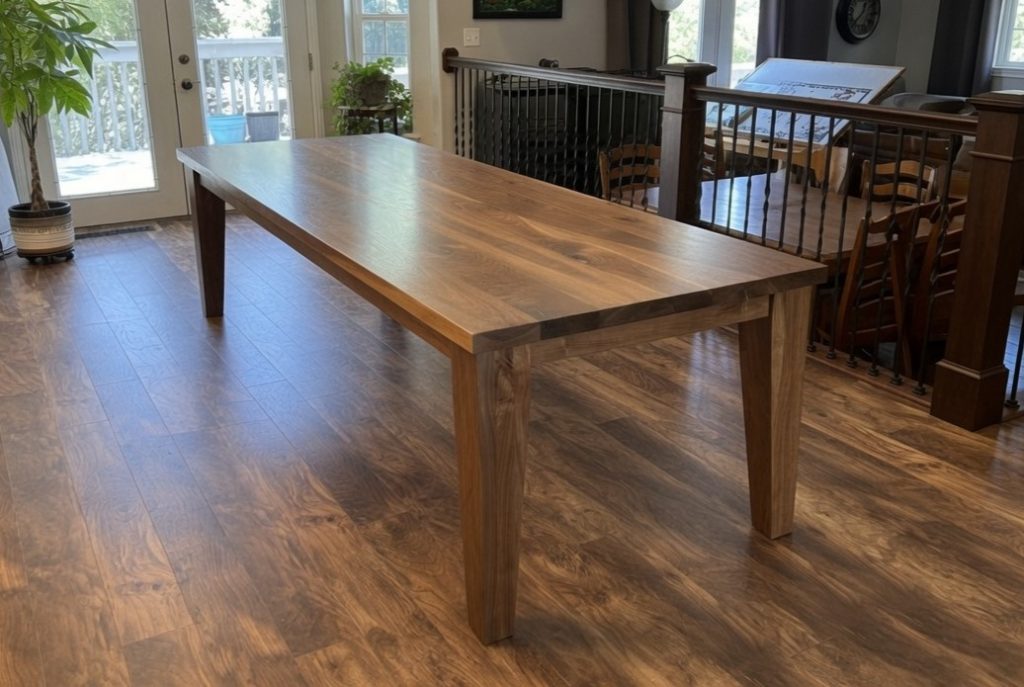
Walnut is the only one of the three that’s dark without any stain, so most walnut tables get a clear finish that lets the natural color show. It has a smooth, fine grain and a richness that’s hard to fake with stain on another wood.

Walnut is softer than either oak, so it dents more easily. In a house with young kids, expect some character marks over the years, or choose our distressed top option, which helps hide them. Walnut also tends to lighten and warm a little with sunlight over time, while oak tends to deepen slightly toward amber.

Which wood is best for families with kids?

If your table is going to see homework, crafts and toddlers, white oak or red oak is the practical choice. Both are harder than walnut and show fewer dents. For more ideas, see our guide to kid-friendly dining tables.

Matching your chairs

Our dining chairs are built by Amish chair makers and arrive already finished. We stain your table to match them, so it’s worth choosing the table wood and the chair finish together.

A note on dry mountain air

All three woods move with changes in humidity, and the dry air in eastern Idaho, Utah and Wyoming can be hard on solid wood. How a table is built and cared for matters more here than which species you pick. We cover that in how to protect solid wood furniture in dry mountain climates.

What about alder?

Our Essentials Collection tables are solid alder. Alder is softer than any of the three woods above, but it’s a smooth, even-grained hardwood, and it lets us batch-build those tables in one size for $2,000.

What it adds to the price

Choosing white oak or walnut adds $1,000 to any of our custom tables. To see how wood, size and delivery add up on a real table, read how much a custom dining table costs.

Still deciding?

Wood is easier to choose in person. Come see finished tables at …

Red Oak vs. White Oak vs. Walnut: Choosing the Wood for Your Dining Table Read More »
How Much Does a Custom Dining Table Cost? Real Prices From Our Rexburg Shop

If you’re pricing a solid wood dining table, here’s the short answer from our shop: our Essentials Collection tables are $2,000, and our fully custom dining tables start at $2,650. Most of the designs in our catalog start between $2,650 and $4,750, and the size and wood you choose move the final number from there.

Below are the real starting prices from our dining tables page as of November 2026, what changes the price, and a worked example so you can estimate your own table before you talk to us.

Starting prices for our tables (November 2026)

DesignStarting price
The Haven$2,650
The Ashton$2,650
The Modern Farmhouse$2,875
Skinny Morrison$2,875
The Morrison$2,950
The Mitchell Rail Table$3,000
Harris Trestle$3,125
The Sentinel$3,375
The X-Beam$3,500
Cascade Round$3,500
The Molina$4,250
The Curtis Round$4,750

Starting prices are for the smallest size, in red oak, with a smooth top. Prices can change, so the dining tables page always has the current numbers.

What changes the price

Size

On our rectangular tables, every extra 6 inches of length adds $100. The Haven and the Sentinel both start at 5 feet long, so a 7-foot table adds $400 and a 9-foot table adds $800. Round tables climb faster, because the top grows in every direction at once. On the Curtis Round, a 5-foot diameter adds $550 and a 6-foot diameter adds $1,050.

Wood species

Red oak is our standard wood. White oak and walnut each add $1,000. White oak gives you a lighter, more natural color without red oak’s pink undertone, and walnut is the only one of the three that’s dark without any stain.

Top finish

A smooth top is standard. A circle-sawn, distressed top adds $200. It’s a good choice if you’d rather your table hide the dings a busy family puts in it than show them off.

Base style and leaves

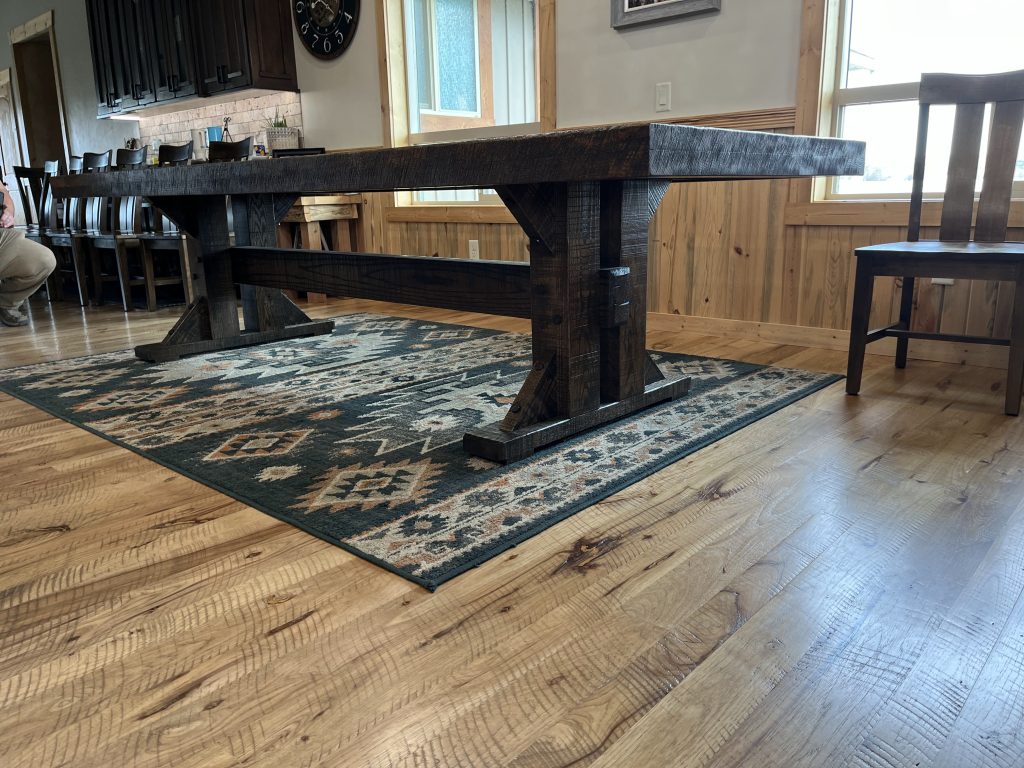
Trestle, pedestal and four-leg bases each change how a table looks and how easily chairs slide in and out. We wrote a separate guide to choosing between trestle, pedestal and four-leg bases. If you want room to grow, we can build extension leaves that store inside the table on trestle and pedestal bases. We don’t build butterfly leaves. Leaves are quoted on your design call.

Chairs

Chairs are priced separately. Our dining chairs are built by Amish chair makers and arrive already finished, and we stain your table to match them so the set looks like it belongs together.

Delivery

Delivery is a flat fee by area, and it never costs more than $500. It’s free anywhere in Madison County, $100 to Rigby, St. Anthony, Idaho Falls and Ammon, $425 to Pocatello or Jackson, and $500 to Salt Lake City, Boise or Bozeman. That price includes carrying the table into the room, assembling and leveling it, and taking the packaging away. If you’d like your old table hauled off on the same trip, that’s $75. Full details are on our delivery page.

A worked example

Say you want a 7-foot Haven in white oak, delivered to Idaho Falls:

  • The Haven, starting price: $2,650
  • 7-foot length: +$400
  • White oak: +$1,000
  • Delivery to Idaho Falls: +$100
  • Total before tax and chairs: $4,150

When the Essentials Collection makes sense

Our Essentials Collection is four of our most popular designs built in one set size, 84 by 42 inches, which seats 6 to 8. They’re solid alder, you pick the stain, and because we build them in batches in our Rexburg shop, they cost $2,000 and ship in 4 to 6 weeks. If that size works for your room and you don’t need a particular wood or length, it’s the least expensive way to get one of our tables.

How payment works

For a custom table, a 50% deposit starts your order and sets your place in the build schedule. The balance is due before delivery or pickup. Essentials tables are paid in full when you order. Written quotes are good for 14 days, because lumber prices move. The full policy is on our orders and deposits page.

Why a solid wood table costs what it does

A custom table is mostly lumber and …

How Much Does a Custom Dining Table Cost? Real Prices From Our Rexburg Shop Read More »

Call Now!